
Knowing Your Needs
from your wants


Inspiration
I recently watched the movie End of the Tour. This is a 2015 film featuring Jason Segal as the famous, late author David Foster Wallace, and Jesse Eisenberg as the journalist David Lipsky who in 1996 joined DFW for the end of his book tour for the now famous and then viral novel Infinite Jest.
I’d been wanting to watch the movie for sometime as my brother had recommended it years ago and I’d started reading Infinite Jest earlier in the year. What compelled me to watch the movie, however, was a confluence of current aspirations and the magic of the YouTube algorithm.
As evidenced from my recent essays, I’ve been focused on time management and in particular how much time we spend on our phones. Nevertheless, one night, I was burning time on my laptop instead of my phone and watching some YouTube videos I’d saved to my Watch Later list. One of these was the following clipped up German interview of DFW from 2003 (full interview here, apparently).
This interview is chock full of insights, but the following one really jumped out to me. This is from starting at about 11:30 in the above video:
If you’re talking about, the more general allure of drugs – to the extent that I understand it, which is the ex-, which is about a specifically as I’m going to talk about it – it seems to me to be, and this isn’t a very original thing to say, it’s a pretty natural extension of corporate capitalist logic, which is: I want to feel exactly the way I want to feel, which is good for exactly this long, and so I will exchange a certain amount of cash for the substance, and I will do it. But it’s all, of course, a lie, because the control gradually goes away, and it stops being that I want to do. It becomes that I feel I need to do it, and that shift from I want something to I feel I need it is a big one. Yes, I mean– most of the problems in my life have to do with my confusing what I want and what I need.
I could probably write a whole collection of essays about different things that DFW says in this interview, but this part about wants turning into needs really struck me. What started as an observation about the nature of chemical dependency turned into a much broader insight about the drugification of the developed world.
Realization
First, being relatively well-read on topics of drug dependency as a result of my interest in psychopharmacology and relatively intense focus on this area of research during my undergraduate years, I was surprised I’d never heard anyone describe addiction in this way. But more importantly, though it seemed more serendipitous than intentional, in making this point about confusing wants and needs, David Wallace points to a pernicious source of suffering in our time.
Hearing this insight from DFW was very grounding. It immediately reminded me to be grateful for having all my essential needs met. I helped me realize that I’d been complaining–at least internally–far too much about not having things I wanted but didn’t need without even realizing it. My needs are beyond sufficiently met, as are many of my wants that I’ve become accustomed to perceiving as needs. If you’re reading this, you’re probably in the same boat.
Knowing the difference between our wants and our needs can lead us to be much more grateful and satisfied with the understanding that our needs are met. Being humble in our means is a lifestyle choice that can lead to greater satisfaction, lower stress, and better relationships. We can choose to reduce our list of wants and instead focus on satisfying our needs. We can come to realize the things we do that started out as actions we took to fulfill a want but became habits that we feel we need to do.1
Reducing our wants to nothing is infeasible. Personally, I’d say my material wants are relatively tamed. I used to be obsessed with shoes; I’m still a little bit of a sneakerhead on the inside, but I don’t spend as much time as I used to looking at new shoes and contemplating which ones I’m going to buy next as I did in high school. I mostly grew out of that as I became more in touch with my values. I think anyone can learn to tame their material desires to a reasonable degree, but having wants, is an ever present part of being human. There’s nothing inherently wrong with having wants, but unchecked and unrealized for what they are can certainly go a long way to making an otherwise content life a life of dissatisfaction.
I’d be amiss if I didn’t acknowledge that – as alluded to by DFW in other parts of this interview – we are living in more and more of a digital and internet-based world and material wants have perhaps become less of a driving factor in our lives as perhaps the addictive allure of online entertainment. All the same, we live in a world with many things that draw us into a wanting trap.
We don’t just confuse our wants with our needs, as Wallace pointed out, but we confuse what society tells us we want with what we really want and fail to realize that what we really want is what we really need, which is something greater than ourselves.
Aspiration
Not long after watching The End of the Tour I read what might just be the best essay I’ve read this year, Abundance of what? Abundance for what? by Brink Lindsey. Here’s a relevant passage:
We are already so rich that economic growth and technological progress have substantially erased — to the extent they are capable of doing so, at any rate — various great deficits that traditionally menaced and degraded human existence: hunger, physical drudgery and suffering, ignorance, and premature death. Our main problem with food these days is too much of it. Our lives are now so sedentary that we pay money to go to gyms to get the physical exercise our body needs. We have all the world’s knowledge available at our fingertips, just a click away on our phones — if we can be bothered to choose learning something new over the umpteenth TikTok video of the day. Funerals for children are now as rare as they are soul-wrecking; they were just as soul-wrecking before, but dreadfully commonplace.
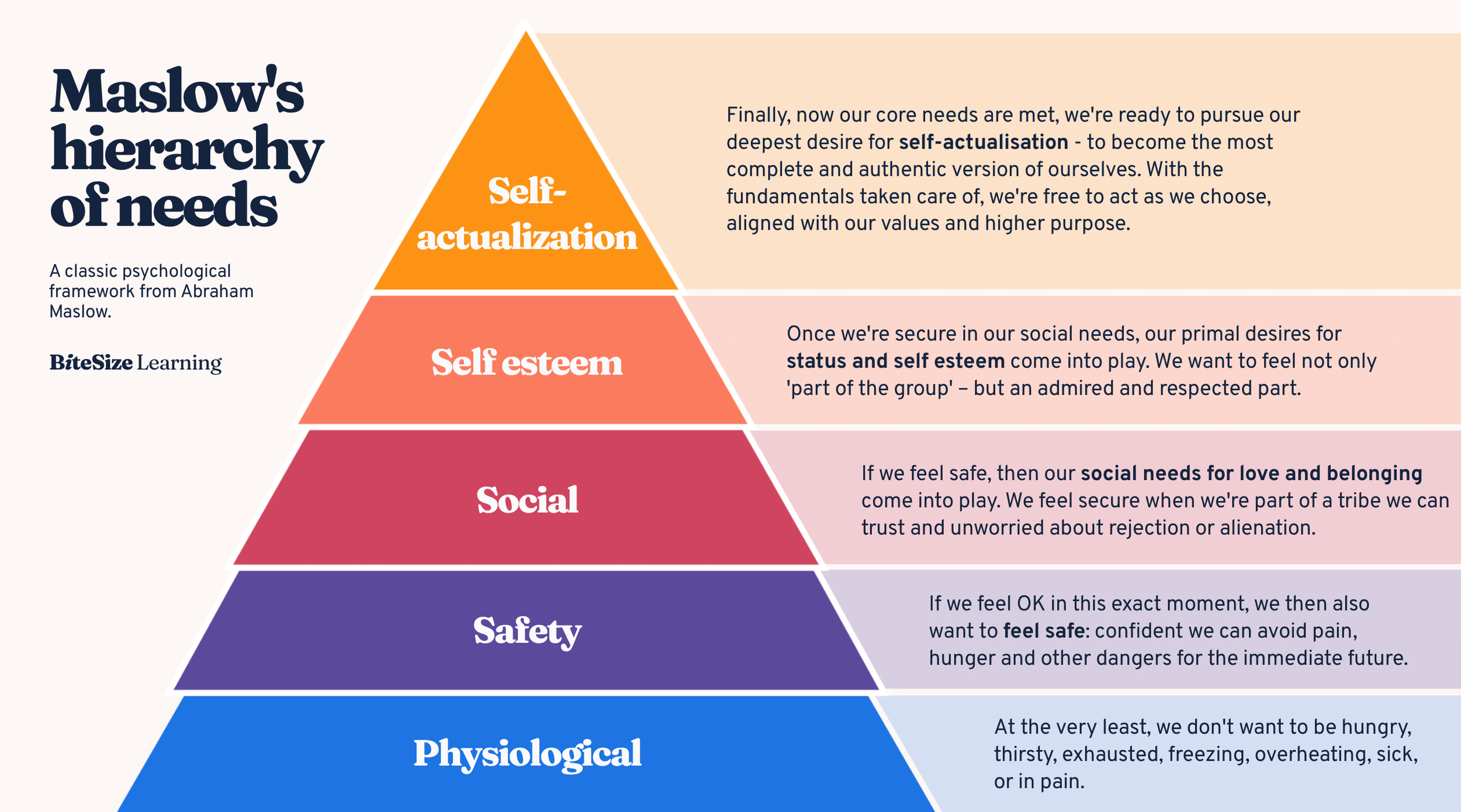
In the context of figuring out what the abundance agenda should really be about, Lindsey points out the irony of the great abundance that already exists. He’s doing this with a larger context of pointing out that despite this, many of us still feel a sort of quiet desperation2 as we spend much of lives working jobs that bring us no intrinsic sense of satisfaction or meaning. Even with our basic needs fulfilled – say, at least the bottom 2 layers of Maslow’s hierarchy (diagram above) – we can be left wanting more, and this is where things get complicated.
Certainly much of this wanting is really a result of higher-level needs not being fulfilled. Needs for social connection, purpose, and meaning. I know these are more than needs in the most basic sense of the word, but these as nonetheless legit needs. But the capitalistic and materialistic society we live in does all it can to convince us that what we need are things that money can buy and we get distracted. Our dissatisfaction finds the wrong source and our wanting energy gets misdirected. We don’t just confuse our wants with our needs, as Wallace pointed out, but we confuse what society tells us we want with what we really want and fail to realize that what we really want is what we really need, which is something greater than ourselves.

Yes, we really do need a rich social life – we are social beings and without quality social connections we suffer3 – and we do need to feel as though life is not completely meaningless, a spiritual need that’s not inherently religious nor theistic but derived from the complexity of our social evolution. This is the need to be part of something greater than ourselves.4
I think the angst and dissatisfaction that can arise despite having our basic needs met can be rightly directed toward what one might call noble wants: wants that motivate us to satisfy these social and spiritual needs. Wanting to live in a peaceful community, wanting to provide for our families and for them to be happy, wanting to help those in need. These are wants that serve our social and spiritual needs. Beyond the desire for things that serve our most basic needs and these higher needs, most wants are trivial. But these noble wants focus us on the only thing outside ourselves that can ultimately provide our lives with meaning and happiness: other humans.
Adendum
If you’ve been following my work here you may have noticed I’ve begun to take quite a shift in my style of writing. I used to mostly write research summaries and lately I’ve been writing what I’ve been thinking of as essays on lifestyle philosophy. I haven’t given up on doing the former, but I’ve been doing the latter because that’s where my heads been at. I’ve been spending more time thinking about practical philosophy than I was when I started this Substack, but I’ve also been spending less time reading research articles.
I certainly don’t think that the health science communication problem that motivated me to begin this Substack has been solved. There’s still a plethora of health grifters and a dearth of honest health science communicators, but frankly my mind and attention have been on the more philosophical side of lifestyle health lately. Quite honestly I’m torn, I’d like to do both, but I only have so much time.
I plan to do more of my classic science communication writing again in the future, or at least share and cite more research like I did in the past, but for now, I hope y’all have enjoyed reading my more pensive prose. Anyways, let me know what you think. I’m always open to feedback and input. Thanks for reading.
BTW, I’m thinking about writing follow ups to these two essays. If you’ve made it this far, let me know which one you think I should prioritize a follow up to first.
Now that RFK’s been in power for 9 months, how’s MAHA looking now?
My opinion on Bryan Johnson has dramatically shifted (to being less favorable) since writing this.


Personally, I’m currently wresting with whether or not I need to: use social media at all, continue my Duolingo streak, and play Wordle everyday.
He doesn’t use this phrase but I’m borrowing it from Thoreau:
“The mass of men lead lives of quiet desperation.” - Henry David Thoreau
No book taught me better to understand the origin of this spiritual drive to be part of something greater than ourselves than Emile Durkheim’s The Elementary Forms of Religious Life along with the superb intellect of my professor who facilitated the class discussions about this book, Lisa Landoe-Hedrick.